On this page
Every garage door company warns you off the springs, and it is fair to wonder whether that is safety advice or a sales pitch. So here is the plain version. A spring that is fitted, tensioned and left alone is about as dangerous as a parked car. A spring that someone starts undoing with the wrong tools, or with the right tools and no training, is the most dangerous thing in the average house. This article explains why that is true, what you can safely do around your springs, and what to do when one lets go.
How dangerous are they, honestly?
The risk is specific, not general. Springs do not leap off doors at random, and a broken spring on a closed door is not about to hurt anyone; the energy has already gone. The hazard appears in three situations: when a spring is being adjusted or replaced, when a door with a failed spring is lifted or run under the opener, and when a spring that is worn or rusted is disturbed by work on a nearby part such as a cable, drum or bracket.
In each case the mechanism is the same: stored energy released faster than a person can react. A hand in the path of a winding bar, a face near a cone that lets go, or a foot under a door that drops. The injuries that result are crush and impact injuries, which is why the advice to leave springs alone is the same from every technician regardless of who they work for.
Where the force comes from
A garage door is heavy. A sectional door with insulated or timber-look panels can weigh more than a grown adult, and even a light roller door curtain is an awkward, top-heavy load. The opener does not lift that weight; it is not built to. The springs do, by storing energy when the door closes and returning it as the door opens, so that a balanced door feels almost weightless in the hand and the opener only overcomes friction.
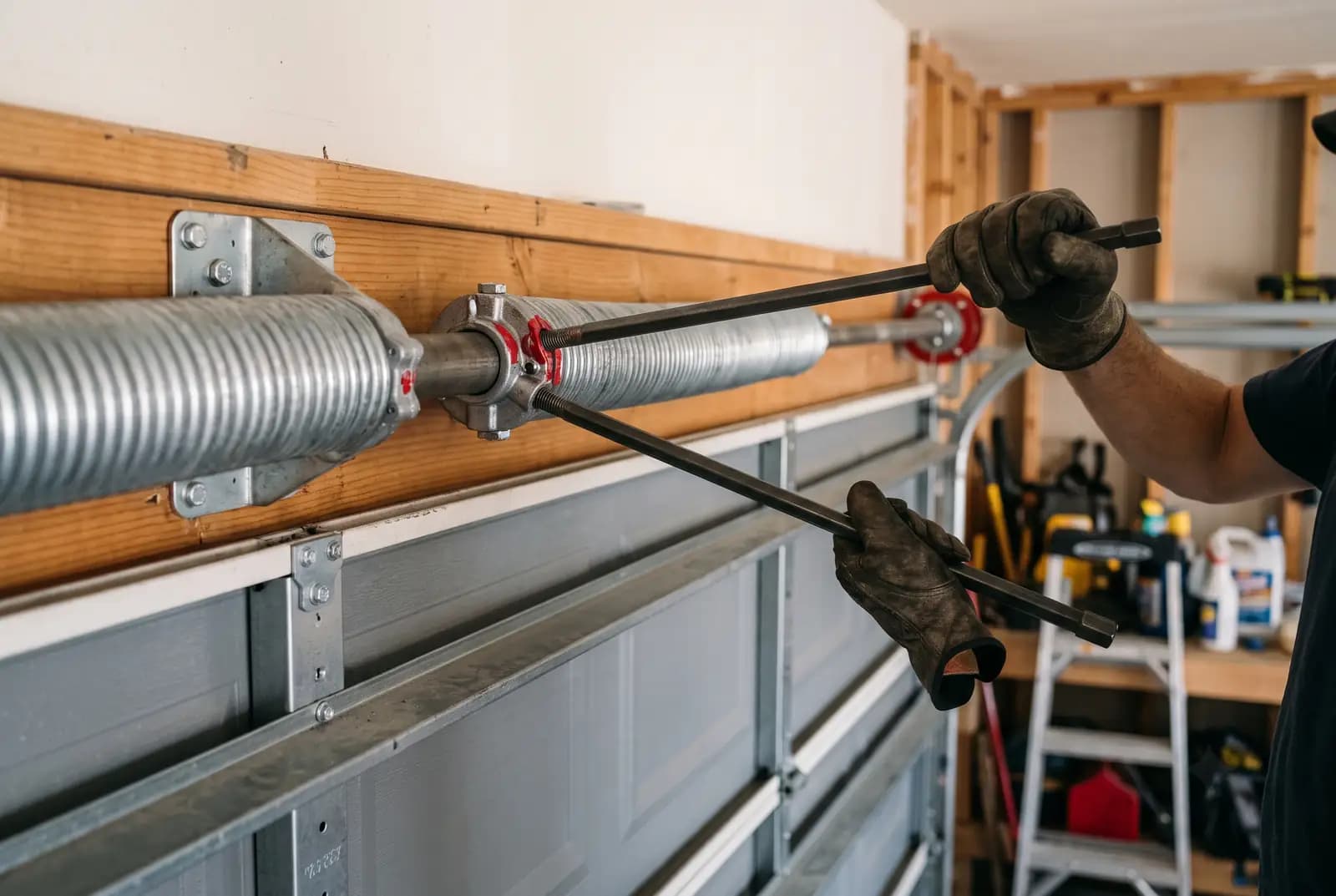
To balance a door of that weight, a torsion spring is wound several full turns onto its shaft and locked with set screws in a cone. Those turns are the stored energy. The spring is under that load whenever the door is closed, which is most of the time, and it remains under partial load even with the door open. It is not a part that can be made safe by closing or opening the door.
- Torsion springs on a sectional door sit on a shaft above the opening, wound tight and held by cones at each end.
- Roller door springs sit inside the drum the curtain wraps around, out of sight and equally loaded.
- Extension springs on older sectional doors stretch along the horizontal tracks and are at full stretch when the door is closed.
- In every case the lift cables carry the door's weight to the spring, so a cable is a loaded part too.
The parts that count as the spring system
Spring, cones and set screws, shaft, centre and end bearing brackets, cable drums, lift cables and bottom brackets. Loosening any one of them can release the others. A bottom bracket in particular looks like an innocent piece of angle iron and is in fact the anchor for a cable under full load.
How people actually get hurt
Talk to technicians and the same handful of scenarios come up. None of them involves a spring doing something unexpected; they all involve a person doing something to a spring.
- Using a screwdriver, a pair of pliers or a length of rebar as a winding bar. The tool slips or bends, and the spring's stored turns unwind through whatever is in the way.
- Loosening the set screws on a cone without a bar in the spring, so the cone spins free with the full load behind it.
- Undoing a bottom bracket to replace a roller or a seal, and releasing the cable that bracket anchors.
- Pulling the manual release on a door whose spring has broken, and taking the entire weight of the door on one arm.
- Running the opener against a broken spring until the cable snaps or the gear strips, then standing under the door.
- Working on a rusted extension spring with no containment cable, so the broken halves fly when it fails.
The common thread is that the person did not know the part they were touching was loaded. That is the honest reason we say leave it: not that the job is hard, but that the mistakes are not obvious until the moment they happen.
Torsion, extension and roller-door springs
Torsion springs are the type on most Perth sectional doors, mounted on a shaft above the opening. Their danger is concentrated at the cones, where the stored turns are locked in. A torsion spring that breaks usually stays on its shaft, which is why a failed one shows as a clean gap in the coil and the door simply becomes heavy. Our guide to torsion vs extension springs explains how to tell which type you have.
Extension springs, found on some older sectional doors, are stretched rather than wound and are anchored at each end beside the horizontal tracks. When one breaks without a containment cable through its centre, the pieces can travel. A containment cable is a cheap addition that makes an old extension system far safer, and a technician can fit one during a service.
Roller door springs are the ones owners underestimate, because they are invisible inside the drum. They are wound to the same kind of tension as a torsion spring and the drum has to be handled as a loaded assembly. Our article on roller door spring tension covers the symptoms of a spring losing its set and why the drum is not an owner job.
Safe to do, never do
Safe for an owner
- Spray the coils of a torsion spring with a garage door lubricant to stop dry rubbing and slow rust.
- Do the balance test: with the door closed and the opener disconnected via the manual release, lift the door halfway and let go. A balanced door stays put.
- Look at the spring from the floor for a gap in the coil, rust pitting or a coil that looks stretched.
- Check that an extension spring has a containment cable running through it.
- Listen for a new groan or pop on the way up, which is the sound of a spring losing tension or rubbing dry.
Never, whatever the video says
- Loosen a cone set screw, a centre bracket, a cable drum or a bottom bracket.
- Wind or unwind a torsion spring, or open a roller door drum.
- Detach or stretch an extension spring, or remove its anchor bolt.
- Lift, release or run a door whose spring has broken.
- Swap a broken spring for one that looks about the same size; wire diameter, length and inside diameter all have to match the door's weight.
The balance test is the useful one
A door that drifts down from halfway has lost tension and is loading the opener and cables. A door that shoots up has too much. Either result is a call to book a garage door service, where a re-tension is $280–$330 incl. GST and takes a technician a fraction of the time it would take you to get hurt.
When a spring has already broken
The classic signs are a loud bang from the garage, then a door that the opener lifts a few centimetres and drops, or will not lift at all. On a sectional door you can usually see the gap in the spring from the floor. On a roller door the curtain becomes very heavy or slams down. Our broken spring or cable page runs through the diagnosis in detail; the short version is below.
- Leave the door in whatever position it is in. Do not run the opener and do not pull the release.
- Keep children, pets and cars clear of the doorway.
- If the car is inside and you need it, say so when you call and the visit is treated as an emergency.
- Do not lift the door with a second person either; two people cannot hold a door that drops.
- Do not fit a temporary fix such as a clamp or a ratchet strap to the shaft.
The reason the release cord is off limits is worth spelling out. On a balanced door the cord hands you a light load and the manual release is a safe, useful thing to know. On a door with a broken spring the cord hands you the whole door, and it will not stay up when you let go.
What a technician does, and the cost
A spring replacement is not a long job for someone who does it every week. The technician secures the door, releases the old spring in a controlled way with proper winding bars, measures the door's weight and the old spring's dimensions, fits a matching spring, winds it to the correct number of turns, checks the cables and drums, then balances the door through its full travel and tests the opener's safety reverse.
- Single spring, fitted and balanced: $240–$280 incl. GST
- Pair of springs on a two-spring door: $440–$550
- Three springs $660–$770; four springs $880–$1,000
- Re-tension of a sound spring that has slipped: $280–$330
- Lift cable replaced or re-seated on the drum: $280–$550
- After-hours emergency: a flat $500 on top of the repair
There is no call-out fee, and the price is confirmed on site before any work starts. The full breakdown, including when we suggest replacing both springs, is on the spring replacement cost guide. The work carries a 12-month workmanship warranty.
The spring is not the dangerous part. The bolt next to it that looks harmless is.