On this page
Springs do the lifting on a garage door; the opener only steers. Which kind of spring your door uses decides how it behaves when it wears, how it fails, what it costs to replace and how safe it is to be around. This guide lets you identify yours from the garage floor and understand the trade-offs, without asking you to touch anything.
One rule applies to every type on this page: springs and the cables, drums and brackets attached to them are under load whenever the door is closed. Nothing here is a set of instructions for adjusting them. If the door feels wrong, the fix is a technician's visit, and the prices are at the end.
Which type is on my door?
Stand inside the garage with the door closed and look up at the wall above the opening, then along the tracks that run back toward the ceiling. Three things you might see:
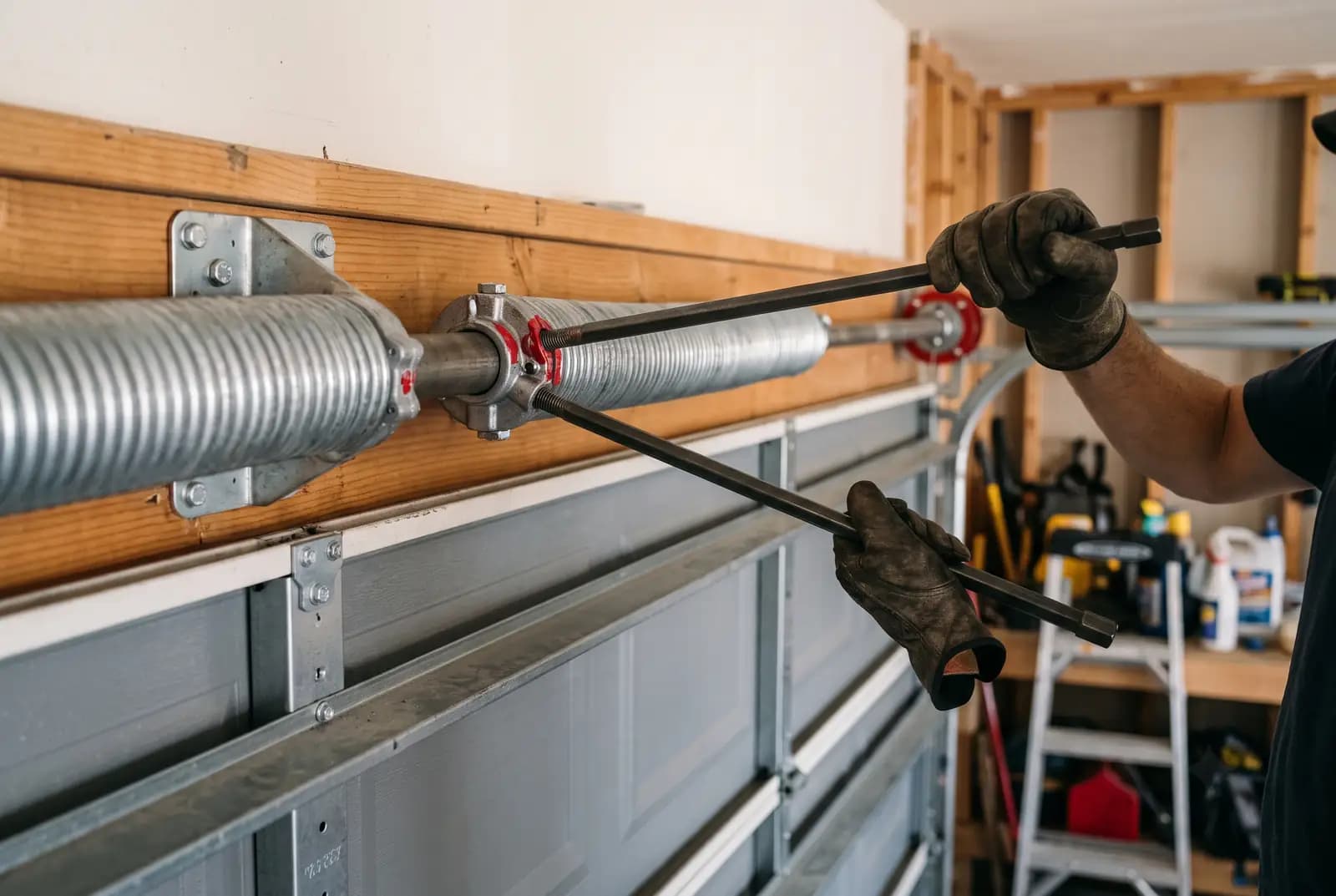
- A steel shaft across the top of the opening with one or two tightly wound coils on it, a drum at each end and a cable running down each side of the door: torsion springs.
- A long, thin spring running alongside each horizontal track, stretched when the door is closed and slack when it is open, with a pulley and cable arrangement at the end: extension springs.
- No visible spring at all, because the door is a roller door whose curtain wraps around a drum: the spring is inside that drum.
A fourth case: tilt doors
A one-piece tilt door pivots on arms at each side and uses springs attached to those arms, usually extension-type. They are replaced as an arm-and-spring kit rather than a single coil; see the cost section for the figure.
Torsion springs, explained
A torsion spring is wound onto the shaft a set number of turns when the door is installed and locked in place with a cone at each end. As the door closes, cables unwinding from the drums turn the shaft and wind the spring tighter; as it opens, the spring unwinds and turns the drums the other way, pulling the cables up and lifting the door. The energy is stored as twist, which is where the name comes from.
Because both cables run off the same shaft, the two sides of the door lift together and the door stays square in its tracks. That is the practical reason torsion systems became the standard on sectional doors: smoother travel, less wear on rollers and tracks, and a spring that stays on its shaft when it breaks instead of flying. The trade-off is that the stored twist is concentrated in a small part, and releasing it needs proper bars and training. Our article on whether garage door springs are dangerous covers that side in detail.
- Sits on a shaft above the opening; needs headroom for the shaft and drums
- Rated in cycles; a heavier door or a longer spring changes the count
- Fails with a bang and a visible gap in the coil, then the door goes heavy
- Replaced singly or as a matched pair on two-spring doors
Extension springs, explained
An extension spring is anchored near the back of each horizontal track and connected through a pulley and cable to the bottom of the door. Closing the door stretches both springs; opening lets them contract and pull the door up. Each side has its own spring, so the two must be matched, and if one weakens faster than the other the door lifts crooked and starts to bind.
Extension systems need less headroom, which is why they turn up on older homes and some lighter doors, and the parts are simple. The drawbacks are uneven lift as the springs age, more rollers and cables to wear, and the way they fail: a stretched spring that breaks has nothing to hold it, and the halves can travel unless a containment cable runs through the coil.
Check for a containment cable
Look for a thin steel cable threaded through the middle of each extension spring and fixed at both ends. Its only job is to catch the spring if it snaps. If yours has none, ask for a pair to be fitted at the next service; it is a small job that removes the worst outcome of an extension spring failure.
Side by side
- Lift quality: torsion lifts both sides from one shaft and stays square; extension relies on two matched springs and can lift crooked as they age.
- Headroom: extension needs less above the opening; torsion needs room for the shaft and drums, though low-headroom kits exist.
- Wear on the door: torsion is gentler on rollers, hinges and tracks because the door does not rack.
- Failure: a broken torsion spring stays on its shaft; a broken extension spring needs a containment cable to stay put.
- Service life: torsion springs generally outlast extension springs on the same door, because the load is spread through more coil.
- Servicing: both need lubrication of the coils and a yearly balance check; neither is an owner-adjustable part.
- Cost to replace: the same price list applies to both; see the cost section.
If you are choosing a new door rather than maintaining an old one, the choice is largely made for you: modern sectional doors are supplied with torsion systems, and the sectional garage doors we install are no exception.
Roller doors and tilt doors
A roller door's spring is a torsion-type coil wound around the axle inside the drum that the curtain wraps onto. It works the same way as a sectional door's torsion spring, storing twist as the curtain unrolls, but it is hidden, and that leads owners to forget it is there. The symptoms of a roller door spring losing tension are a curtain that becomes heavy, drifts down from open or slams shut; our guide to roller door spring tension walks through them and explains why the drum is a technician-only assembly.
Tilt doors, the one-piece type that swings out and up, use springs on the pivot arms at each side. When they wear, the door becomes heavy to lift and drops fast on the way down. They are renewed as an arm-and-spring kit, which is a different price line from a sectional or roller-door spring.
Is converting worth it?
Owners with an old extension system sometimes ask whether to convert the door to torsion springs. It can be done, provided there is headroom for a shaft above the opening, and the benefits are real: even lift, less wear, a safer failure mode and generally a longer spring life. The cost is the new shaft, drums, bearing brackets, springs and cables plus the labour, so it is a bigger job than a like-for-like replacement.
- Worth considering when the extension springs are due anyway, the door and tracks are sound, and the door will stay for years
- Worth considering when the door lifts crooked and binds because the two extension springs have aged differently
- Not worth it when the panels are tired and a new door at $3,000–$5,000 incl. GST is on the horizon; that door comes with torsion springs
- Not possible without the headroom for the shaft and drums
The honest answer for most doors is to replace like for like, add containment cables if they are missing, and put the conversion money toward the next door. We quote both on site so you can compare; the garage door repairs page lists what a visit covers.
Replacement cost in Perth
Springs are priced by how many the door runs, because the labour is in the winding and balancing rather than the part. The figures below are from our current price list, incl. GST, with no call-out fee and the exact price confirmed before work starts.
- Single torsion, extension or roller-door spring, fitted and balanced: $240–$280
- Pair of springs on a two-spring door: $440–$550
- Three springs $660–$770; four springs on oversized or commercial doors $880–$1,000
- Re-tension of a sound spring that has slipped or lost set: $280–$330
- Lift cable replaced or re-seated on the drum: $280–$550
- Tilt-door arm kit with springs: $1,200–$1,800
- After-hours emergency attendance: a flat $500 on top of the repair
On a two-spring door we recommend replacing both, because they have done the same cycles and the survivor is close behind. The spring replacement cost guide explains that and the other things that change the price. Work carries a 12-month workmanship warranty.
Torsion or extension, the spring that hurts people is the one someone decided to adjust.