On this page
Of every part on a garage door, the springs work the hardest and get thought about the least — right up until the morning one lets go with a bang and the car is stuck behind a door that won't budge. Across the Perth metro area, a snapped spring is the single most frequent reason our phone rings.
Below is everything a Perth homeowner actually needs to know: what the springs are doing while you're not looking, which of the two systems your door runs, realistic lifespan numbers, current replacement prices from our own price list, and the one rule about springs that keeps people out of the emergency department.
What garage door springs actually do
Here's the part that surprises most people: your opener doesn't lift the door. A sectional door weighs anywhere from 80 kg to 180 kg, and no household motor moves that on its own. The springs carry the load — they wind up with stored energy as the door comes down, then hand it back as the door rises, leaving the motor to do little more than steer and hold. On a properly balanced door, the motor is lifting the equivalent of a few kilograms.
This is also why a snapped spring masquerades as a motor failure. Suddenly the opener is trying to hoist the entire door by itself — it groans, shudders a few centimetres, and quits. Swapping the opener at that point achieves nothing except cooking a second motor on the same broken door.
Quick test
Disconnect the opener with the manual release cord and raise the door by hand to about waist height, then let go gently. A healthy door feels light on the way up and holds its position. A door that fights you or drops the moment you release it has spring trouble.
Torsion vs extension springs
Every counterbalanced door in Perth runs one of two spring systems. Identifying yours takes ten seconds and tells your technician exactly what to bring.
Torsion springs
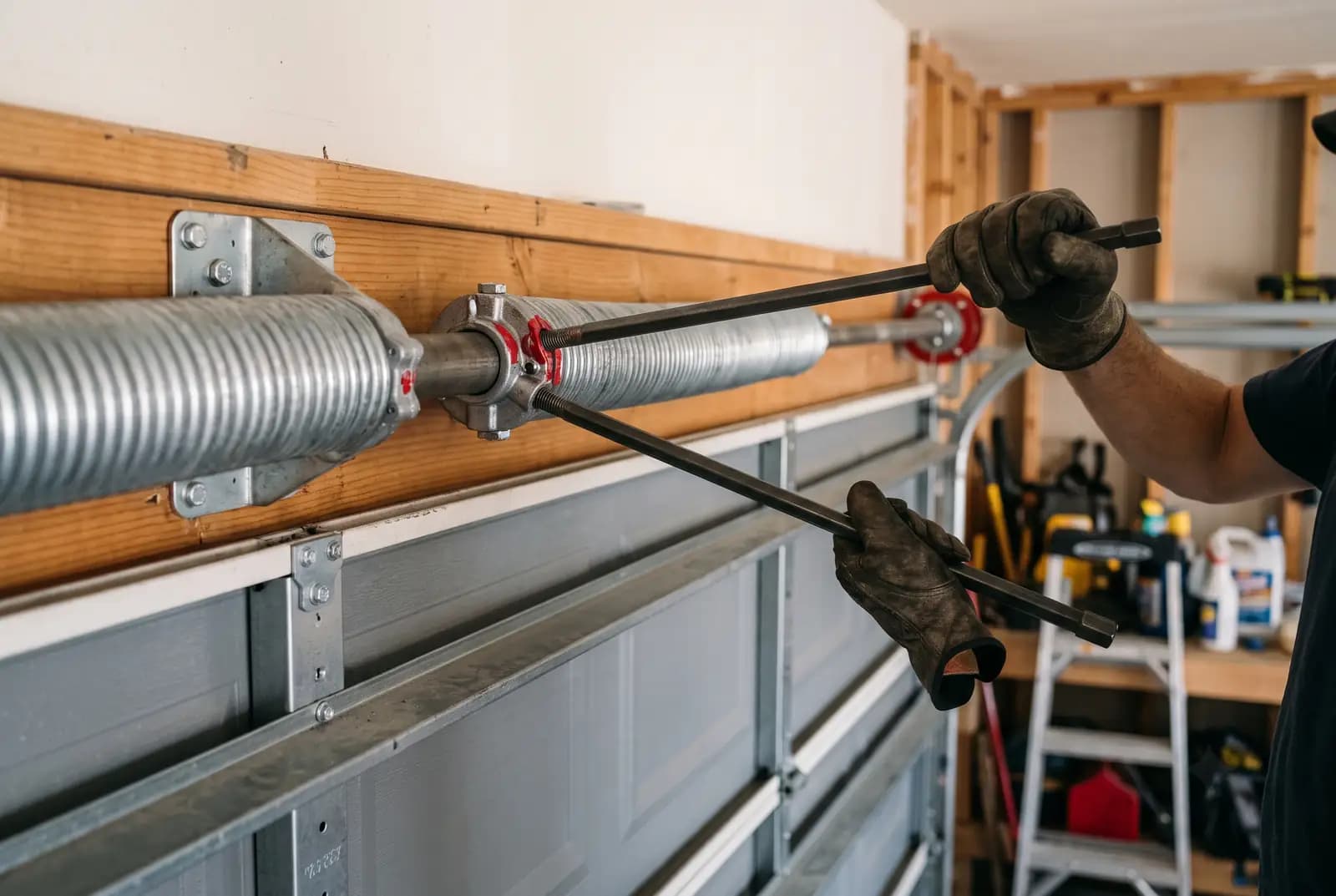
Look above the door opening: coiled springs wrapped around a horizontal steel shaft are torsion springs, the modern standard on sectional doors. They store energy by twisting, which delivers even, controlled lift through cables and drums at each end of the shaft. Torsion systems run quieter, keep the door level, last longer, and when they finally break they generally stay put on the shaft. Single doors usually run one or two; wide, insulated or commercial doors can carry three or four.
Extension springs
Long springs stretched alongside the horizontal tracks are extension springs — typical of older tilt doors and budget installs. Each side works independently, so wear pulls the door out of level over time, and the constant full-length stretching fatigues the steel faster than twisting does. Crucially, a snapped extension spring recoils hard, which is why each one must have a containment cable threaded through it. Older Perth doors are routinely missing these.
- Torsion — coils on a shaft above the opening; longer life, better balance, contained failure; today's standard
- Extension — stretched beside the tracks; shorter working life, must have containment cables; common on older tilt doors
- Roller doors — springing hidden inside the curtain barrel, serviced as an assembly rather than as individual springs
For a deeper side-by-side, see our breakdown of torsion vs extension springs.
How long garage door springs last
Manufacturers rate springs in open-close cycles, not calendar years — a standard spring is built for about 10,000 of them, and high-cycle versions for 20,000 or beyond. How fast you burn through that budget depends entirely on how the household uses the door.
Translated into years, the arithmetic looks like this:
Expected spring life by usage
- Two cycles a day (single-car household): 12–14 years
- Four cycles a day (typical family): 7–9 years
- Six or more cycles a day (big households, tradies working from home): 4–6 years
- Commercial and strata doors: frequently under 3 years unless high-cycle springs are fitted
Perth adds a wrinkle the rating charts don't mention: salt. Homes within a few kilometres of the coast — Fremantle, Scarborough, Hillarys, down through Rockingham and Mandurah — see springs corrode well before their cycle count runs out, because rust pits become crack points. Near the beach, galvanised or coated springs repay their small premium many times over.
Springs fail in pairs
Two springs fitted together accumulate the same fatigue. When the first one goes, its twin is living on borrowed time — most follow within months. One visit at $440–$550 for the pair beats two separate call-outs and keeps the door lifting evenly.
Warning signs a spring is failing
A spring rarely dies without notice. These are the signals worth acting on:
- A single gunshot-like bang from the garage — the sound of a spring letting go, often mistaken for an intruder
- A visible break or gap in the coil above the door
- The opener lifts a few centimetres, strains, then reverses or gives up
- The door feels like dead weight on the manual release, or crashes down instead of lowering
- One side of the door rises ahead of the other, or the door sits visibly crooked
- Cables gone slack, frayed, or jumped off their drums
- Movement that's turned jerky, or fresh grinding and squealing noises
Stop using the door
Once you suspect a spring, stop running the opener. Each press drives the door's full weight through the motor, cables and brackets — quietly converting a $240 spring job into a springs-plus-cables-plus-motor job. Leave the door where it sits and give us a call.
If the door is already stuck, our garage door spring repair team carries the common Perth spring sizes on the van, so the right spring is usually on hand without a second visit. Stuck shut outside business hours? See emergency garage door repairs.
Are garage door springs dangerous?
Genuinely, yes — and not as a scare tactic to win your business. A wound torsion spring on a double door is holding several hundred newton-metres of energy in a coil of hardened steel. Let that out in an uncontrolled way and it breaks hands, takes fingers, and occasionally worse. Australian emergency departments treat garage-door injuries every year, and the serious ones overwhelmingly involve someone attempting their own spring or cable work.
What makes it treacherous is a combination of three things: you can't see tension (a fully wound spring looks identical to a slack one), the correct winding bars are specialist tools most sheds don't contain, and getting the replacement tension wrong leaves a door that either slams or won't stay open. There's no way to 'feel your way' through the job safely.
Powered garage doors fall under Australian Standard AS/NZS 60335.2.95 from Standards Australia, and WorkSafe WA classes high-tension spring work as a job for trained, properly equipped operators — a bar set for tradespeople, not weekend DIY. We've unpacked the whole topic in are garage door springs dangerous?
What you can safely do yourself
Watch, listen, and balance-test with the opener disconnected. Keep tracks free of junk. What you never do: loosen brackets, wind or unwind springs, touch cable drums, or remove containment cables. The moment a job involves releasing tension, it belongs to a technician.
Spring replacement cost in Perth
Straight from our current price list — supplied, fitted, old springs removed and the door re-balanced:
- Single broken spring — $240–$280, our most common repair
- Matched pair (×2) — $440–$550, the sensible option when both springs are the same age
- Three springs — $660–$770, for wider and heavier doors
- Four springs — $880–$1,000, on oversized, insulated or commercial doors
- Re-fit or re-tension healthy springs — $280–$330, when tension has drifted but the coils are sound
- Lift cable replaced or re-seated — $280–$550, frequently needed after a spring lets go
- After-hours or emergency attendance — a flat $500 on top
Where a job lands inside those ranges comes down to door size and weight, the number of springs fitted, spring gauge, and whether cables, drums or brackets took collateral damage when the spring failed. Quoting is free with no call-out fee, and the figure is locked in before we touch the door. The full breakdown lives on our spring replacement cost page, or the price calculator will give you a range in under a minute.
Be careful with cheap quotes
A fitted spring priced well below $200 is usually one of two things: a light-gauge spring that won't see out half its rated cycles, or a re-tension of the very spring that just failed. Always ask for the gauge, the cycle rating, and what the warranty actually covers.
Repair, re-tension, or replace?
A snapped coil can't be welded back to life — once broken, a spring is replaced, full stop. The real decision is how far to go while a technician is on site:
- Re-tension only ($280–$330) — right when the springs are intact and the door has simply drifted out of balance. The cheapest correct fix.
- Replace just the broken spring — reasonable when the two springs are different ages, or the survivor is nearly new.
- Replace the pair — our default advice on same-age springs: one visit, even lift, no repeat call-out three months later.
- Step up to high-cycle springs — on busy or commercial doors, roughly double the rated life for a modest price difference.
One more honest consideration: on a door past its twentieth birthday with tired cables, rollers and drums all round, weigh the repair against the price of a new door before committing. Our garage door repair cost guide shows where that trade-off usually tips.
Making your springs last longer
You can't add cycles to a spring's rating, but you can stop it wasting them. Premature spring death is nearly always caused by the rest of the door making the springs fight for every lift.
What actually helps
- Keep the door balanced — imbalance overloads one spring while the other coasts
- Replace seized or flat-spotted rollers; friction is invisible extra weight
- Twice a year, lubricate rollers, hinges and the shaft bearings with a garage-door lubricant — and never grease the tracks
- Deal with new noises and jerky travel early instead of normalising them
- Near the ocean, hose salt off the door occasionally and choose galvanised springs at the next change
- Book an annual once-over — $120 for a safety check-up, or a full service from $140 plus parts
That yearly service is the cheapest insurance a garage door can get: spring fatigue, fraying cables and balance drift all show themselves to a technician long before they strand you. More on timing in how often you should service a garage door, or book through our garage door maintenance team.
Most weeks, the majority of our "the motor's died" calls end with us holding a snapped spring. The motor never stood a chance — it was asked to lift a door on its own.