On this page
Searches for how to tension a roller door spring usually come from someone whose door has suddenly become a two-person lift, or whose opener is straining. It is a fair question, and the honest answer is that the fix is straightforward for a technician and dangerous for anyone else. This guide explains what the spring does, how to tell when the tension is wrong, and why we will not publish a winding procedure. It ends with what a visit involves and what it costs.
What the spring inside the drum does
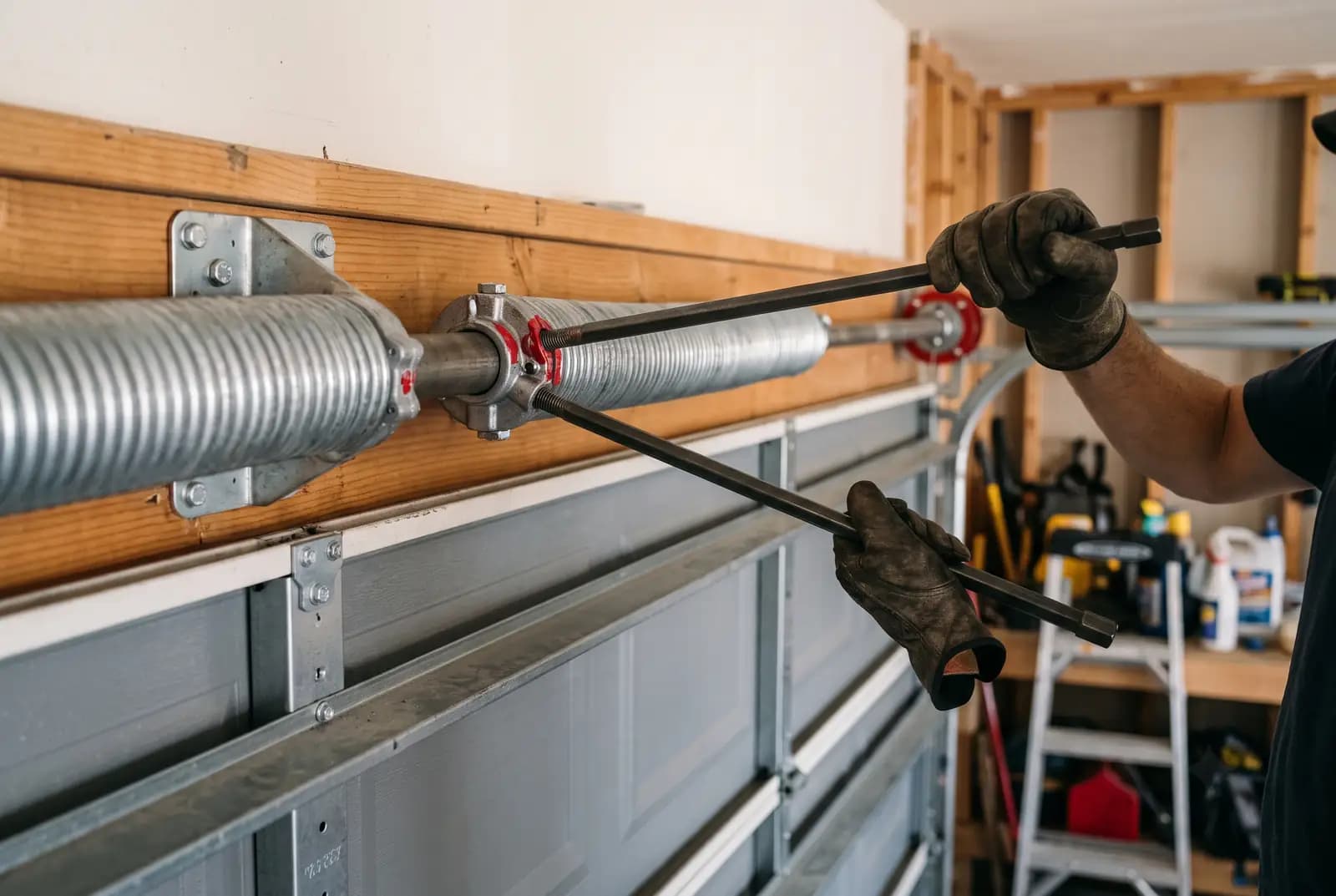
A roller door's curtain wraps around a drum at the top of the opening. Inside that drum runs an axle, and around the axle sits one or more long coil springs, anchored at one end to the axle and at the other to the drum. As the curtain unrolls to close, the drum turns and winds the spring tighter. That stored twist is the tension, and it is sized to balance the weight of the curtain, so that a closed door has enough stored energy to help lift it, and an open door has just enough left to stay up. The opener, if there is one, only has to overcome friction and a little imbalance; the spring does the real work.
Tension is set when the door is installed, by winding the drum a set number of turns before the curtain is fixed to it. It is not a setting that drifts on its own. When it changes, something has happened: the spring has fatigued and lost some of its strength, the anchor has slipped, a bracket bolt has loosened and let the axle turn, or someone has partly wound it off during other work.
Symptoms of wrong roller door spring tension
Too little tension
- The door is heavy to lift by hand, and gets heavier the closer it is to the floor.
- An open door drifts or drops down on its own instead of staying up.
- The opener strains, slows near the bottom of travel, or reverses because its force limit trips.
- The curtain slams the last part of the way when closing.
- The curtain sags between the guides or scrapes the floor on one side.
Too much tension
- The door races upward once started and bangs against the stops at the top.
- It is hard to pull down and will not stay closed without the lock.
- The curtain balloons outward from the drum or rides up unevenly, and in bad cases starts to unravel from the drum.
- The opener struggles to close the door and may reverse near the floor.
A broken spring
A spring that snaps gives a loud bang from the drum and a door that suddenly weighs what a sheet of steel weighs. The door may drop, sit crooked, or refuse to move at all. It is not a tension problem; the spring needs replacing, and the door should not be operated by hand or motor until it is. Our broken spring or cable guide covers the immediate steps.
Why we do not publish tensioning steps
The spring is inside a drum that also carries the full weight of the curtain, two and a half metres up, on brackets that hold the whole assembly to the wall. Adjusting tension means partly unloading that spring while controlling the drum against it. If the grip slips, the drum spins with the force of the whole wound spring behind it, and anything in the way, from a hand to a face to the ladder, takes that force. Curtains have unrolled from the drum onto the person below. Brackets have torn from the wall.
There is also no reliable way for an owner to know how many turns a given door needs. It depends on the curtain's weight and height, the drum diameter and the spring specification, and getting it wrong in either direction produces the symptoms above and shortens the spring's life. Technicians carry the tools that hold the drum under control, know the specifications for the common door brands, and can tell a fatigued spring from a slipped one by feel. Our springs safety guide goes into the physics for sectional doors, and the same energy is involved here.
What owners should not touch
Do not loosen the U-bolts, bracket bolts or grub screws at either end of the drum. Do not try to hold the drum with pipe wrenches, bars or rope. Do not release the curtain from the drum. Do not run the opener against a door that has become heavy; it hides the fault until the motor fails too.
What you can safely check
Owner checks
- With the opener released and the door closed, lift the curtain a short way by the bottom rail. Balanced means it lifts with one hand and stays where you leave it at waist height.
- Look along both guides for a curtain that sits unevenly or rubs on one side, which can look like a tension fault but is often a guide or bracket problem.
- Check the guides are clean and dry. Grit and old grease add friction that mimics a weak spring; our lubricant guide explains what roller door guides should and should not get.
- Listen for a bang from the drum during use, or a clunk at the same point in every cycle, and note it for the technician.
- Stop using the door if it drops, slams or has started to unravel, and lock it closed until it is looked at.
What a technician does on the visit
The visit starts with the balance test above and a look at the drum, brackets and guides. If the spring is intact and simply under- or over-wound, or has slipped, the technician secures the drum with the proper tools, resets the tension to the door's specification, refixes the anchors and re-checks the balance through the full travel. If the spring has fatigued to the point that correct tension cannot be reached, or it has broken, it is replaced, often with the curtain removed from the drum and re-fitted. The opener's force and travel limits are then re-learned so the motor is not compensating for a door that no longer needs it.
Prices from Elite's list, incl. GST: a spring re-fit or re-tension, where the existing spring is sound, is $280–$330. A new single spring supplied, fitted and tensioned is $240–$280. Both are part of our roller door repairs service, which also covers guides, lock arms, curtains and motors, and there is no call-out fee.
When to call
Call as soon as the door becomes heavy, drifts, slams or races, and immediately if you have heard a bang, seen the curtain balloon, or found the door crooked in its guides. A door that is used heavy for weeks wears out its opener, and a curtain that unravels can be beyond straightening. Elite attends roller door repairs across Perth 24/7; an after-hours visit adds a flat $500 to the repair price, so a weekday call for a merely heavy door is the cheaper decision.