On this page
Most squeaks, grinding and stiff spots in a garage door trace back to dry metal. The good news is that lubrication is the maintenance job an owner can do properly in twenty minutes, twice a year. The catch is that the wrong product on the wrong part makes a door worse, and the shelf at the hardware store offers half a dozen cans that all look right. This guide sorts the products first, then walks the door part by part.
The four lubricant types, compared
Silicone spray
A thin, clear lubricant that goes on wet and leaves a slick film that does not gum up. It is safe on plastic, nylon and rubber, which matters because modern rollers often have nylon wheels and every door has rubber seals. Silicone is the all-rounder for hinges, roller bearings and weather seals. Its weakness is staying power under heavy load, so it needs reapplying more often on springs.
White lithium grease
A thicker grease, usually in a spray can with a straw, that clings to metal-on-metal surfaces for months. It suits the opener's chain or screw drive and steel hinge pins on heavy doors. Because it is sticky, it also holds dust, so it is the wrong choice anywhere exposed to Perth's sand and wind, and it should never go near nylon rollers, tracks or seals.
Dry PTFE spray
Goes on wet, flashes off, and leaves a dry, slippery coating that does not attract grit. That makes it the pick for anything near the floor or the outside face of the door, and for coastal and dusty suburbs where oily films turn into grinding paste. It wears faster than grease, so it wants topping up every few months.
Purpose-made garage door lubricant
Several brands sell a can labelled for garage doors. These are typically a silicone or PTFE base blended for metal, plastic and rubber together, so one can covers the whole door without harming seals. If you only want to buy one product, this is it. Read the label: a few are lithium-based and carry the same dust warning as white lithium grease.
What not to use
General-purpose penetrating spray is a solvent and water displacer, not a lubricant. It strips whatever film was there, feels smooth for a day, then leaves the metal drier than before. Engine oil, chain lube for bikes and heavy grease belong nowhere on a garage door: they drip onto the car, hold grit, and clog the tracks.
How to lubricate a garage door, part by part
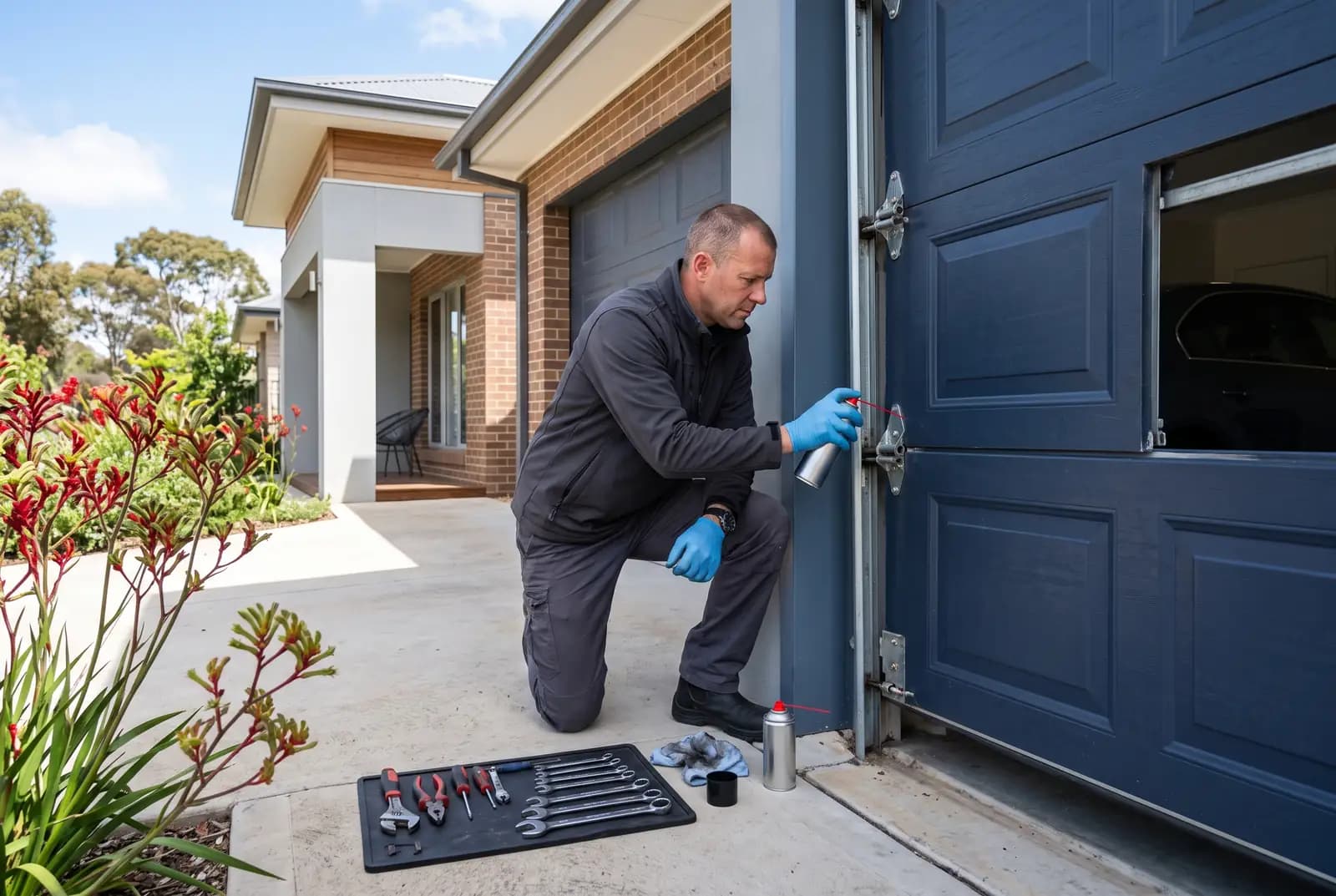
Close the door and switch the opener off at the power point so nobody operates it while your hands are near the hinges. Wipe each part with a dry rag before spraying; lubricant on top of dirt just makes mud. Work from the top of the door down so drips land on parts you have not done yet.
Sectional door checklist
- Hinges: a short burst into the pin of every hinge along the panel joints, then work the door by hand a few centimetres to spread it.
- Rollers: spray the bearing where the wheel meets its stem, not the wheel face. Nylon wheels get silicone or PTFE only.
- Torsion spring: a light coat along the coils cuts the twang and slows rust. Do not touch the winding cones, set screws or the cable drums, and never try to adjust the spring; our springs guide explains why.
- Lift cables: a mist where they wrap the drum. If you see broken strands, stop and book a cable replacement instead.
- Opener drive: chain and screw drives take a thin film of lithium grease or the maker's specified lubricant. Belt drives get nothing.
- Bottom seal and side seals: silicone keeps the rubber supple and stops it grabbing the concrete.
- Tracks: wipe clean, and leave them dry. Rollers should roll along a track, not slide on a film.
Roller doors are different
A roller door has no hinges or wheeled rollers. The curtain slides in two vertical guides, and the spring lives inside the drum at the top. The guides want to be clean and dry, or at most given a wipe of dry PTFE: grease in a roller door guide collects sand, scores the curtain and makes the door heavier to lift, not lighter. The drum bearings at each end of the axle take a small amount of silicone. If the door is still heavy or noisy after that, the spring tension is the issue, and that is a technician's job, covered in our roller door spring tension guide.
How often, and how much
Twice a year suits most Perth doors: once before winter, when rain and cold stiffen everything, and once at the end of summer, after months of dust. Doors within a few kilometres of the coast, and doors on busy driveways that cycle many times a day, benefit from a quarterly pass. A light film is the aim; if lubricant is dripping, you have used three times too much and the excess will end up on the floor and the car.
Lubrication does not fix a door that is out of balance, has worn rollers, or has a spring at the end of its life. If the door still groans, sticks halfway or slams down after a proper lube, those parts need a noisy door diagnosis rather than another can of spray.
When to call a technician
- The door is heavy to lift by hand with the opener released, which points to spring tension, not friction.
- Rollers are cracked, wheels are flat-spotted or hinges have visible play.
- Frayed lift cables, a gap in the torsion spring coils, or a roller door curtain that has started to balloon or unravel.
- The opener strains, hums or stops partway even though the door moves freely by hand.
An annual garage door service covers all of this: balance and tension checks, rollers and hinges, a full lubrication with the right products in the right places, and the safety tests, from $140 plus parts, incl. GST. It is the cheapest hour a garage door gets.