On this page
Two identical doors, installed the same week — one in Midland, one in Scarborough. A decade later the Midland door is mid-life; the Scarborough door has been through a set of springs, a cable, and a scatter of seized rollers. Nothing was wrong with the coastal door. Everything was wrong with where it lived. From Mandurah up through Fremantle, Cottesloe, Scarborough and Hillarys, salt is the quiet tax on every garage door — and it's a tax you can substantially negotiate down.
Why salt beats steel
Sea spray loads the air with microscopic salt particles that settle on everything downwind. Salt is hygroscopic — it pulls moisture out of the air — so every salted steel surface spends its nights wearing a thin, conductive, corrosive film. That film turns ordinary rusting into a faster electrochemical attack, and it concentrates damage at exactly the worst places: the microscopic surface pits of high-tension spring steel and the strand gaps of braided lift cables.
The pit-to-crack problem
A spring doesn't need to rust through to fail early — it only needs a pit. Each corrosion pit is a stress concentrator in steel that flexes thousands of times a year, and cracks start at pits long before the metal looks visibly 'rusty'. That's why coastal springs fail short of their cycle rating.
Which parts fail first
- Springs — the flexing, high-tension steel where pits become cracks; the classic early coastal failure
- Lift cables — braided strands trap salt and moisture between them, fraying from the inside out
- Fixings and brackets — track bolts, hinge screws and bottom brackets seize or weaken quietly
- Roller bearings — salt washes lubricant out and grinds what's left; sticky rollers overload everything upstream
- The curtain or panels — cosmetic surface rust at scratches and cut edges, ugly before it's structural
- Opener electronics — the least affected, but coastal humidity still shortens board life at the margins
The coastal owner's checklist
The 20-minute seasonal routine
- Rinse the door — outside face, bottom edge and tracks' exteriors — with fresh water every month or two; more often after storms and strong sea breezes
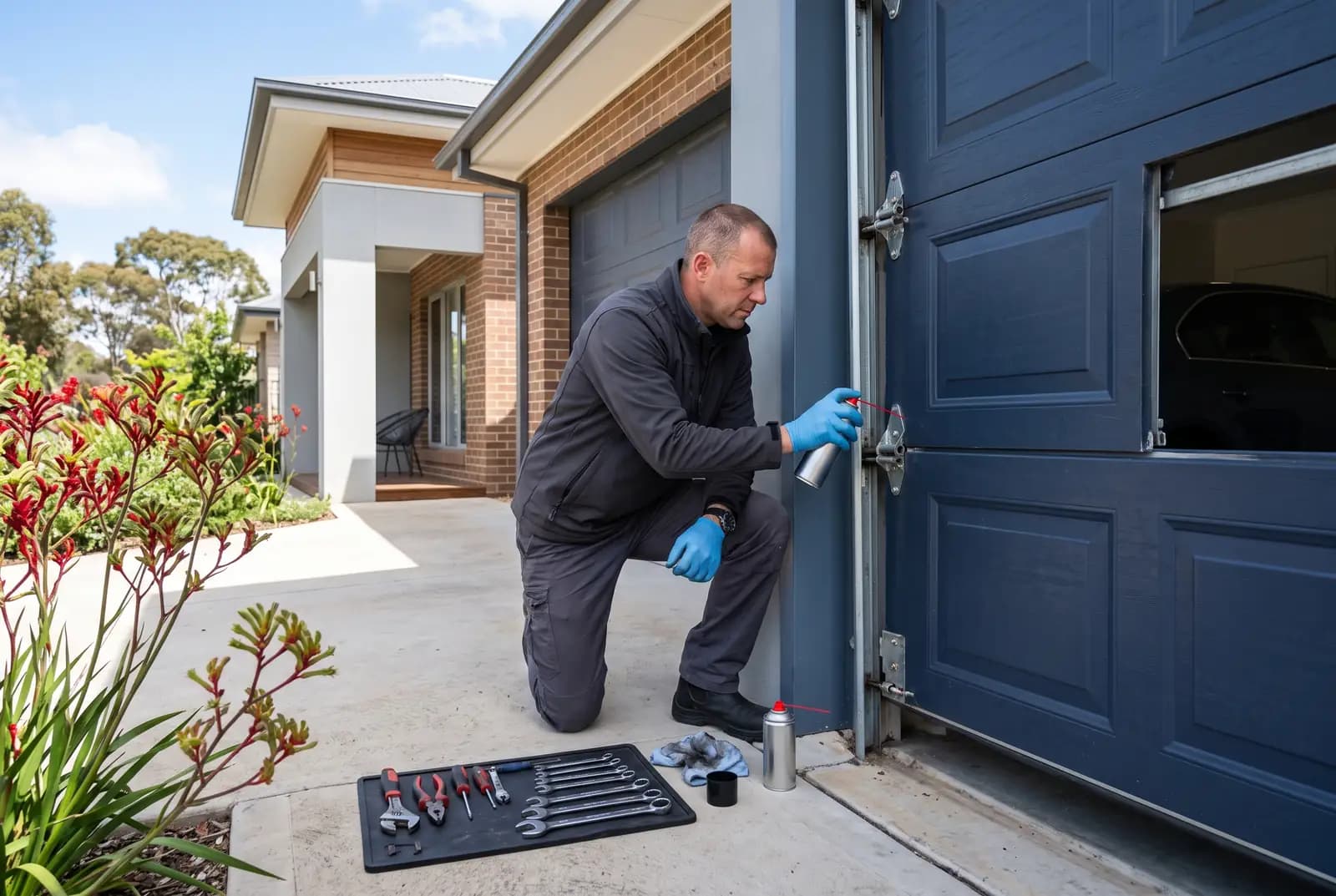
- Twice a year, lubricate springs, hinges and roller bearings with a garage-door lubricant (lanolin-based products hold up especially well in salt air) — and keep it out of the tracks
- Run a cloth along the bottom rubber seal and check it for cracking; a perished seal lets salty air circulate under the door all night
- Eyeball the springs and cables from a distance each season: surface rust bloom, a visible pit line, or any frayed strand is a book-the-technician sign, not a watch-it sign
- Check fixings for rust weep stains — brown streaks below a bolt head mean corrosion is active behind it
- After any repair, confirm what grade of parts went in — galvanised or zinc-coated, or you'll repeat the repair early
The unchanged rule
Coastal or not, springs, cables, drums and bottom brackets stay hands-off — corrosion makes tensioned parts less predictable, not more. Rinsing and lubricating are owner jobs; anything under tension belongs to a technician.
Smarter choices at replacement time
The cheapest moment to fight salt is when a part is being replaced anyway. Galvanised or zinc-coated springs cost a little more than bare steel and routinely outlast them near the water — the same $240–$280 single-spring job either buys you the coastal problem again or buys you out of it. The logic repeats down the parts list: stainless or coated fixings, sealed-bearing nylon rollers, and powder-coated panels and curtains all shrug off the salt that eats their bare-steel equivalents. New-door buyers should say the word 'coastal' early — it changes the hardware spec we quote, as covered on our new garage doors hub.
Full spring pricing — including the matched-pair logic that applies double near the beach, since both springs corrode together — is in our spring replacement cost guide, and the deeper mechanics live in the garage door springs guide.
The right service interval near the beach
Inland doors do well on an annual service. Within that first few kilometres of coast, we recommend 6–9 months — not as an upsell, but because the failure clock genuinely runs faster and the service exists to catch pit lines, fraying strands and washed-out bearings while they're cheap. A full service is from $140 plus parts; a standalone 20-point safety check-up with a written report is $120. Either is a rounding error against the emergency call-out it prevents — details on the service cost page, or see how often you should service a garage door for the full interval logic.
You can pick a coastal door blindfolded: run a finger along the bottom bracket and feel the grit. The owners who rinse and lubricate get years more from every part — it's the cheapest maintenance win in the trade.